Ketamine Nasal Spray
At-Home Telehealth Treatment
A fast-acting delivery method that provides rapid symptom relief with the convenience of at-home administration — no clinic visits, no infusion chairs. Prescribed by Dr. David Mahjoubi, MD for depression, anxiety, PTSD, and chronic pain.
NutraBrain is one of the only online telehealth clinics that prescribes ketamine nasal spray for home use.
Rapid relief you can use at home
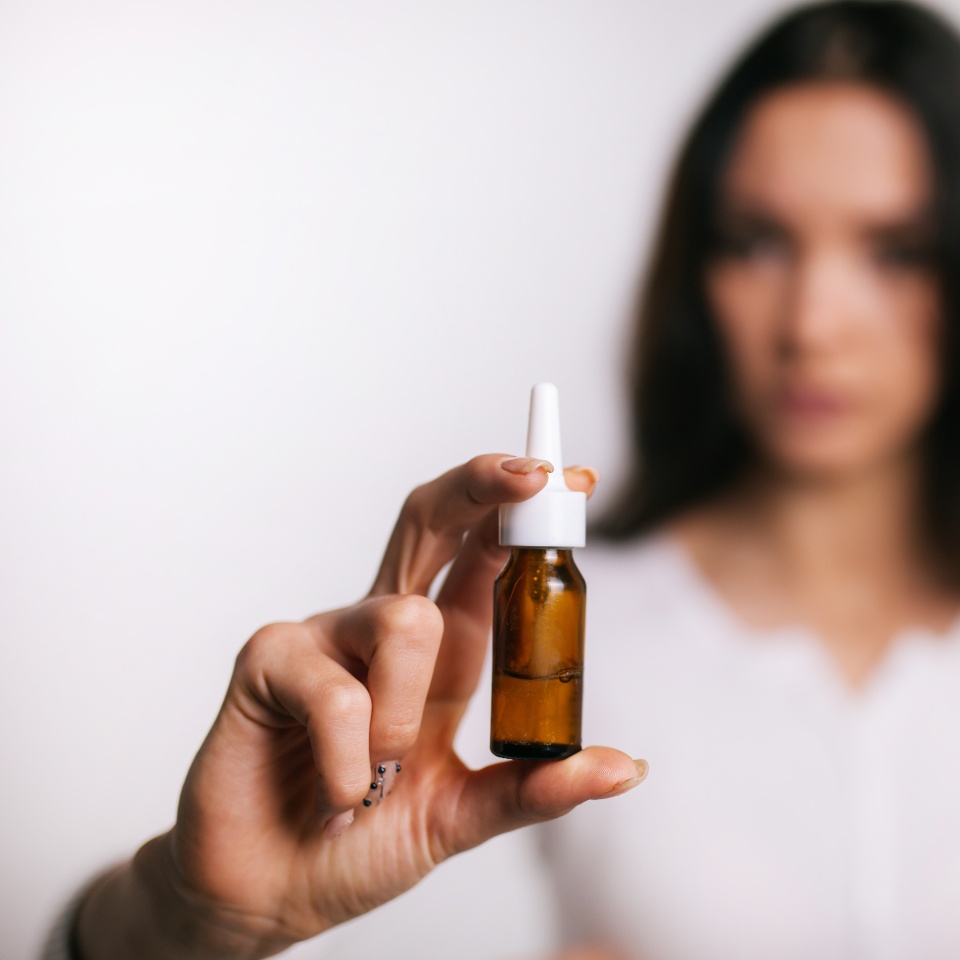
Ketamine nasal spray is one of the fastest and most convenient ways to access the benefits of ketamine therapy. The spray is absorbed directly through the lining of the nose, so it reaches the bloodstream and the brain quickly — often producing noticeable relief within minutes rather than the longer wait associated with swallowed or sublingual ketamine.
Fast onset
Absorbed through the nasal lining, it enters the system faster than any oral or sublingual route of ketamine.
Greater bioavailability
More of each dose reaches your bloodstream compared with swallowed or under-the-tongue ketamine.
At-home convenience
No infusion appointments and no certified-clinic visits — administered discreetly at home.
Ready to see if nasal spray is right for you?
Our new-patient form takes just a few minutes to complete.
What the research shows
Ketamine has been studied across mood, trauma, anxiety, and pain conditions. Below is a plain-language summary of the published evidence. Use of ketamine for these conditions is generally off-label, and individual results vary.
Depression
Ketamine is one of the most studied rapid-acting antidepressants. In a randomized, double-blind, placebo-controlled trial, 44% of patients responded within 24 hours of intranasal ketamine, compared with just 6% on placebo — and it was well tolerated with minimal dissociative effects.1 Systematic reviews and meta-analyses of controlled trials confirm a fast-onset antidepressant effect with intranasal ketamine, with adverse effects that are typically mild and transient.2
PTSD
Research led by Dr. Adriana Feder at Mount Sinai provided the first controlled evidence that ketamine can rapidly reduce PTSD symptoms. In a randomized trial of repeated dosing, 67% of the ketamine group were treatment responders, versus 20% on the active placebo, with meaningful improvement in trauma symptoms and good tolerability.3
Anxiety
In studies of treatment-resistant generalized and social anxiety disorder, patients reported reduced anxiety within one hour of dosing, with relief lasting up to a week. With maintenance dosing, the large majority of patients reported ongoing improvement in social and work functioning.4 This rapid, calming effect is part of why so many of our patients find the spray valuable for day-to-day anxiety (see microdosing, below).
Chronic pain
Ketamine blocks the NMDA receptor, which plays a central role in “central sensitization” — the process by which the nervous system becomes locked into a heightened pain state. By dampening that signaling, ketamine can help break the chronic pain cycle. The strongest evidence is in neuropathic pain and complex regional pain syndrome (CRPS), where consensus guidelines rate the evidence as moderate.5
Have a condition you’d like to treat?
Tell us about your goals on the new-patient form and we’ll review whether nasal spray is a good fit.
Dr. Mahjoubi's clinical experience since 2014
Dr. David Mahjoubi, MD has been prescribing ketamine since 2014, and the nasal spray has become a cornerstone of his practice. Over that time, his patients have generally reported that they find the nasal spray more effective than the sublingual ketamine tablet (troche). In his clinical experience, this difference comes down to two things the research also supports: the nasal route has greater bioavailability (more of the dose actually reaches your system) and a quicker onset of action (you feel it sooner).
This long, hands-on track record is part of what makes NutraBrain different from clinics that have only recently added ketamine to their menu. We’ve spent years refining how we dose, combine, and adjust the nasal spray to fit each patient.
How our nasal spray differs from Spravato (esketamine)
Johnson & Johnson’s Spravato is an FDA-approved esketamine nasal spray — but it is only one mirror image of the ketamine molecule. Ketamine is what chemists call a racemic molecule, meaning it naturally exists as two mirror-image forms (the R- and S-enantiomers). Spravato contains only the S-mirror image (esketamine). The nasal spray we prescribe contains both mirror images — the complete, racemic ketamine molecule.
Why does that matter? A growing body of research suggests the R-mirror image contributes meaningfully to ketamine’s benefits and may be linked to longer-lasting effects. In fact, a meta-analysis of dozens of randomized controlled trials found that racemic ketamine consistently produced larger and more sustained antidepressant effects than esketamine, with greater remission rates and fewer dropouts due to side effects.6
| Feature | NutraBrain Ketamine Nasal Spray | Spravato (Esketamine) |
|---|---|---|
| Molecule | Both mirror images (full racemic ketamine) | One mirror image only (S-enantiomer) |
| Where you use it | At home, on your schedule | Certified clinic only, every dose |
| Typical cost | Often around $100 per bottle (240 sprays) | Can be very expensive with a deductible |
| Conditions | Flexibly prescribed off-label (depression, anxiety, PTSD, pain) | FDA-approved for treatment-resistant depression |
| Can combine with oxytocin | Yes | No |
Beyond Spravato, our nasal spray also gets into your system faster than any sublingual or oral route of ketamine — which is why so many patients prefer it.
Skip the clinic. Treat from home.
See why patients choose NutraBrain’s at-home nasal spray over clinic-only options.
A game-changer for daytime anxiety: microdosing instead of benzodiazepines
One of the most popular ways our patients use the nasal spray is microdosing for anxiety throughout the day. Because the spray works quickly and the dose is easy to control, many patients use it as a calmer, gentler alternative to benzodiazepines like Xanax (alprazolam), Ativan (lorazepam), or longer-acting ones such as Klonopin (clonazepam).
Benzodiazepines can be habit-forming and carry risks of tolerance, dependence, and sedation. For patients who want quick, on-demand relief from anxiety without reaching for a benzo, low-dose ketamine nasal spray has been a genuine game-changer. (Never stop or change a prescribed benzodiazepine on your own — any transition should be done under the supervision of your prescriber.)
Combining with oxytocin for added benefit
A unique advantage of the nasal route is that ketamine can be combined with oxytocin in the same spray. This matters because oxytocin is a peptide that is poorly absorbed when taken orally or sublingually — the digestive system breaks it down. Delivered through the nose, however, oxytocin can travel directly along nerve pathways to the brain, which is why intranasal delivery is the preferred route in the research.7
For our patients, adding oxytocin to the nasal spray can enhance the antidepressant benefit of ketamine, and oxytocin carries the added benefit of supporting libido and feelings of connection — something the oral and sublingual forms simply can’t deliver as effectively. NutraBrain offers one of the only ketamine + oxytocin nasal spray formulations in the country.
Common questions about the ketamine nasal spray
-
In general, since Dr. David Mahjoubi, MD began prescribing ketamine in 2014, he has found that the nasal spray works better for most patients. This is attributed to its greater bioavailability and quicker onset of action — more of the dose reaches your system, and you feel it sooner.
-
For some patients, yes. Not everyone loves the nasal spray route, since it can cause occasional congestion or nasal irritation over time. Many of our patients take a break and switch to the oral form for a couple of months before returning to the nasal spray. Having both options means we can keep you comfortable without interrupting your treatment.
-
Absolutely. We commonly combine the nasal spray with oxytocin for greater efficacy in depression. Oxytocin has the added benefit of supporting libido, and it works far better through the nasal route than it would orally or sublingually.
-
We work with several compounding pharmacies around the country to serve patients in different states, so an exact price can't be quoted in advance and will depend on your pharmacy and location. As a general guide, the average is about $100 for 240 sprays. The cost may rise slightly — to roughly $150 for 480 sprays — and a little more if oxytocin is added. We'll always help you find an affordable option.
-
No — and that's what sets NutraBrain apart. We are one of the only online telehealth clinics that prescribes ketamine nasal spray for home use. Most nasal-spray patients are otherwise sent to a certified clinic for Spravato, which can be expensive and inconvenient. Our patients treat from home.
Simple, affordable pricing
Because we use a network of compounding pharmacies across different states, your exact price depends on your pharmacy and location. Here’s what patients typically see:
| Option | Typical Cost |
|---|---|
| 240 sprays | ~ $100 (average) |
| 480 sprays | ~ $150 |
| With oxytocin added | Slightly higher |
Compare that with clinic-administered Spravato, which — with a deductible — can be dramatically more expensive and requires a trip to a certified office for every single dose.
Start your at-home ketamine nasal spray journey
Join the patients who’ve made the switch to fast-acting, convenient, at-home treatment. Completing the new-patient form is the first step.
References
- Lapidus KAB, et al. A Randomized Controlled Trial of Intranasal Ketamine in Major Depressive Disorder. Biol Psychiatry, 2014. PMC4185009
- Gill H, et al. Intranasal Ketamine for Depression in Adults: A Systematic Review and Meta-Analysis of Randomized, Double-Blind, Placebo-Controlled Trials. Front Psychol, 2021. PMC8204747
- Feder A, et al. A Randomized Controlled Trial of Repeated Ketamine Administration for Chronic PTSD. Am J Psychiatry, 2021. Am J Psychiatry
- Glue P, et al. Effects of ketamine in patients with treatment-refractory generalized and social anxiety disorders. J Psychopharmacol, 2020. J Psychopharmacol
- Cohen SP, et al. Consensus guidelines on ketamine for chronic pain; review of CRPS and neuropathic pain evidence. Systematic review of RCTs
- Bahji A, et al. Comparative efficacy of racemic ketamine and esketamine for depression: a systematic review and meta-analysis. J Affect Disord, 2021. Discussion
- Quintana DS, et al. Advances in the field of intranasal oxytocin research. Mol Psychiatry, 2021. PMC7815514