Is Ketamine Therapy Safe at Home?
Reviewed and authored by Dr. David Mahjoubi, MD — Board-Certified Anesthesiologist, President of the American Board of Ketamine Physicians (ABKP), Founder of NutraBrain Clinic. Practicing ketamine medicine since 2014. Author of The Art & Science of Ketamine Medicine.
If you’ve researched ketamine therapy for depression, anxiety, PTSD, or chronic pain, you’ve probably seen one version of it that takes place in a clinic — IV infusions in a recliner under direct medical supervision — and another that happens at home, where a compounded prescription arrives in the mail and you self-administer. The natural question is whether the at-home version is actually safe.
I’ve been prescribing ketamine since 2014 and have personally treated over 3,900 patients across clinical and at-home settings. The short answer is that at-home ketamine therapy is safe for the right patient, at the right dose, under the right physician oversight — and unsafe outside of those conditions. Here’s what each of those qualifications actually means.
Six decades of safety data behind the drug itself
Ketamine has been FDA-approved since 1970 — over fifty years of clinical use across emergency rooms, operating rooms, intensive care units, battlefield medicine, and pediatric anesthesia. The World Health Organization lists it on its Model List of Essential Medicines specifically because of its safety profile in resource-limited settings. In anesthesiology, where I trained, ketamine is one of the few drugs that preserves protective reflexes at therapeutic doses, which is why we use it in unstable trauma patients and children. The doses used for at-home mental health treatment are sub-anesthetic — typically 5 to 15 times smaller than the doses used in surgical anesthesia. The pharmacological safety margin is enormous. What changes between a hospital and a home is not the drug. What changes is the context, the oversight, and the formulation.
What “at-home ketamine therapy” actually means
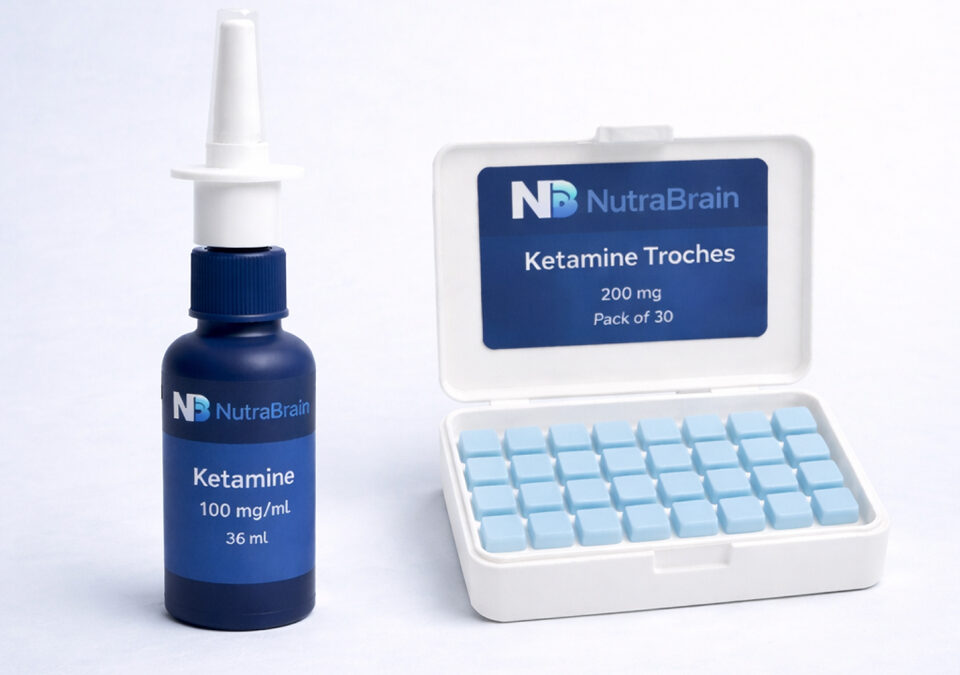
The phrase covers two very different things. The first is medically prescribed, pharmacy-compounded ketamine delivered as a nasal spray, sublingual troche, or rapidly dissolving tablet, in standardized sub-anesthetic doses under a prescribing physician’s protocol. The second is diverted, unregulated, or recreational ketamine purchased outside the medical system. When this article discusses safety, it refers exclusively to the first.
The five pillars of safe at-home ketamine therapy
Safety in this setting comes from five specific safeguards working together. If your program has all five, the safety profile is excellent. If it’s missing any, risk goes up.
1. Thorough medical evaluation before prescribing
A safe program requires a full medical history, a current medication list, blood pressure documentation, screening for uncontrolled psychiatric conditions, and explicit identification of contraindications. At NutraBrain this is done via structured intake plus a video consultation with me directly.
2. Compounding by a licensed U.S. pharmacy
Your medication should come from a 503A or 503B compounding pharmacy operating under state board oversight. NutraBrain uses Novel Compounding (Sylmar, CA), Apothicare 360 (Lee County, FL), and The Chemist Shop (Long Island City, NY). Every batch has a verifiable Certificate of Analysis.
3. Dosing within proven sub-anesthetic range
Therapeutic at-home doses are typically 50–100 mg sublingually or 50–75 mg intranasally per session for mental health indications, calibrated to patient response. Nowhere near anesthetic territory.
4. Patient education on what to expect
A reputable program walks you through the experience before your first dose: the timeline of effects, what dissociation feels like, what to do if you feel uncomfortable, and what’s normal versus what isn’t.
5. Ongoing physician oversight, not one-and-done prescribing
A safe program has the prescribing physician available between sessions, reviews patient-reported effects, and adjusts the protocol over time. If you can’t email your doctor a real question and get a real answer, that’s a safety problem.
Side effects — what’s normal, what isn’t
Common, expected: mild dizziness, transient nausea, mild dissociation (the intended therapeutic effect at the right dose), brief blurred vision, drowsiness. These resolve quickly and don’t require intervention.
Not normal — contact your prescriber immediately: severe vomiting that won’t stop, disorientation lasting more than two hours, severe anxiety or panic during the session, chest pain or palpitations, shortness of breath, or a measurable blood pressure spike.
Who shouldn’t use at-home ketamine
I turn down candidates with active psychosis or uncontrolled bipolar disorder with manic features; uncontrolled hypertension or known unstable cardiac disease; severe substance use disorder without stable recovery; pregnancy; glaucoma with elevated intraocular pressure; an at-home environment that isn’t safe; or patients who cannot commit to follow-up communication. Most patients are fine candidates. Some aren’t, and saying so up front is part of how the program stays safe overall.
Why a board-certified physician matters
Programs staffed entirely by nurse practitioners can still be safe, but they place the safety burden on protocols rather than individual clinical judgment. The benefit of working with a board-certified physician is that the doctor evaluating you and adjusting your protocol has spent over a decade managing this drug at every dose range. I founded the Ketamine Healing Clinics of Los Angeles in 2014 and Orange County in 2021, currently serve as President of the American Board of Ketamine Physicians, and authored The Art & Science of Ketamine Medicine, the only physician-authored ketamine treatment manual in print.
Frequently asked questions
-
The sub-anesthetic doses prescribed for at-home use have a wide safety margin. Accidentally exceeding your dose is most likely to produce unpleasant but transient sedation and dissociation. That said, take only your prescribed dose.
-
Ketamine has abuse potential, which is why it is Schedule III. At sub-anesthetic doses under physician supervision and the dosing protocols used at NutraBrain, addiction risk is low. We screen for risk factors before and during treatment.
-
Bioavailability differs by route. IV is 100%, intranasal is approximately 25–50%, sublingual is approximately 20–30%. Dosing protocols account for this. Published research and clinical experience support that intranasal and sublingual routes can produce significant antidepressant and anxiolytic effects at appropriate doses.
-
Stop immediately. Lie down. The effects are short-acting and resolve within an hour. Contact your physician or 911 if anything feels emergent. NutraBrain patients have direct email access to me.
The bottom line
At-home ketamine therapy is safe for the right patient under the conditions described above. The way to evaluate any at-home program is to check whether the five pillars are all present and whether the physician you’re working with has the clinical experience to handle the unusual cases. If you’d like to find out whether you’re a candidate, take our 20-second qualifying quiz or schedule a video consultation with me directly.
Medical disclaimer: This article is for informational purposes only and does not constitute medical advice. Ketamine therapy is a prescription treatment and should only be undertaken under physician supervision. Individual outcomes vary. Ketamine use for mental health and chronic pain conditions outside of FDA-approved esketamine (Spravato) is considered off-label. Speak with a qualified physician about whether ketamine therapy is appropriate for you.
Last reviewed: June 2026
Posted on behalf of
Phone: (818) 570-1640